

In the demanding environments of compressed air systems, metalworking, and power generation, oil mist is more than just a nuisance—it is a critical threat to equipment longevity and product purity. While standard filtration systems can stop large dust particles, achieving true industrial cleanliness requires specialized Air Filters For Air Purification.
This is where the High Efficiency Air Filter comes into play. But how does a modern Air Filter Element transform microscopic oil fog into manageable liquid? The answer lies in the elegant physics of three specific filtration mechanisms.
The Challenge: Why Is Oil Mist Hard to Catch?
Industrial oil mist typically consists of droplets ranging from 0.01 to 10 microns. These tiny aerosols are so light they behave almost like gas molecules, bypassing simple "sieve" type filters. To remove them effectively, the filter media must utilize a multi-layered matrix—usually high-grade borosilicate glass microfibers—to force the oil particles into contact with the fibers.
The Three Pillars of Coalescence Physics
1. Diffusion (Brownian Motion)
For the smallest particles (typically below 0.1 microns), they do not travel in a straight line. Instead, they are bombarded by gas molecules, causing them to move in a random, zig-zag pattern.
The Physics: This erratic movement increases the probability that the particle will eventually "vibrate" into a fiber within the Air Filter Element.
Practical Note: This is why a High Efficiency Air Filter is so effective at cleaning air even from extremely fine smoke or oil fog.
2. Direct Interception
Medium-sized particles (roughly 0.1 to 1 micron) follow the streamline of the airflow.
The Physics: If the particle's path takes it within one-half of its diameter from a fiber, it makes physical contact and adheres due to Van der Waals forces.
3. Inertial Impaction
Larger, heavier oil droplets (above 1 micron) have significant momentum.
The Physics: When the air stream suddenly twists through the dense fiber matrix, these heavy droplets cannot change direction as fast as the air. They "crash" into the fibers directly.
From Capture to Drainage: The "Coalescing" Phase
Capturing the droplet is only half the battle. If the oil stays on the fiber, the filter will quickly clog (high pressure drop). In professional Air Filters For Air Purification, the coalescence process allows captured micro-droplets to travel along the fibers, collide, and merge into larger drops. Once they reach a certain mass, gravity pulls them down through the filter media to the drainage zone.
Why Source from a Comprehensive Base like SG Filter?
Physics is constant, but the execution varies. At Jiangxi Sange Filter (SG Filter), we understand that a "one size fits all" approach doesn't work for global industries.
2,000+ Models: We provide precision-matched Air Filter Element options for brands like Atlas Copco, Ingersoll Rand, and specialized industrial machinery.
In-house R&D Testing: Our Ganzhou-based production center features dedicated testing labs to measure pressure drop and oil carryover, ensuring every High Efficiency Air Filter we ship meets international standards.
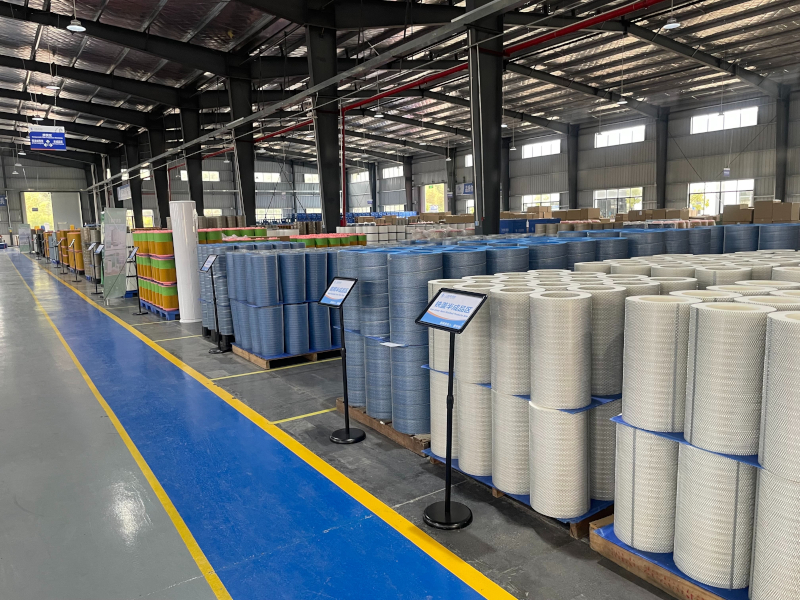
Integrated Production: From the housing to the internal media, we control the entire manufacturing process across our 18,000㎡ facility.
Improve Your Air Quality Today
Looking for a reliable OEM/ODM partner for high-precision industrial filters? With an annual capacity of 650,000 air/oil separators and millions of filters, SG Filter is ready to support your supply chain.